The Vital Question: Tracing the Argument
Intro
This book is structured rather like a review of the literature. When discussing a question, Nick Lane first walks through the existing theories, so part of the pleasure of reading it is following his thinking as he explains a theory and then rules it out. The downside is that it is not always an easy read, and I sometimes lose track of the main argument. Here, then, is a chronological outline of the theory he puts forward.
Energy for Organic Synthesis: Proton Gradients at Alkaline Hydrothermal Vents
Since the Miller–Urey experiment in the 1950s, we have known that inorganic substances can form organic compounds with an input of energy from lightning. Lane, however, considers the energy supplied by lightning far too small: it would not be enough to build up a sufficiently high concentration of organic compounds in a pot of “primordial soup.” He favors a different source of energy—the proton gradient created by alkaline hydrothermal vents.
When groundwater penetrates deep into the Earth’s crust, it reacts with olivine, a silicate containing magnesium and iron, mainly producing serpentine and hydrogen. Magnesium hydroxide is also formed in the process. The overall result is an alkaline hydrothermal fluid rich in hydrogen.
Under ordinary conditions, hydrogen and carbon dioxide cannot react directly. At the same pH, hydrogen ions have a lower reduction potential than formate and are therefore more likely to gain electrons, so hydrogen atoms will not give theirs up. Raising the pH increases both reduction potentials together, leaving the reaction unable to proceed. In other words, although the reaction is exothermic, there is an initial barrier. Alkaline hydrothermal environments create a very different situation: thin inorganic walls formed by catalysts such as iron sulfide can sustain different proton concentrations on either side. This reverses the relationship between the reduction potentials and drives the reaction spontaneously. Organic molecules such as methane and methanol can therefore be produced continuously in alkaline hydrothermal systems.
The Emergence of LUCA
As alkaline hydrothermal fluids mix with cooler seawater, thermophoresis concentrates organic molecules—especially large ones—within a relatively small area. In this environment, amino acids can polymerize into proteins, fatty acids can assemble into vesicles, and nucleotides can form RNA. This is where the famous LUCA (Last Universal Common Ancestor) emerged: by definition, the common ancestor of living organisms. It is worth remembering that LUCA need not have been the first life, only the last common ancestor. Those are not necessarily the same thing.
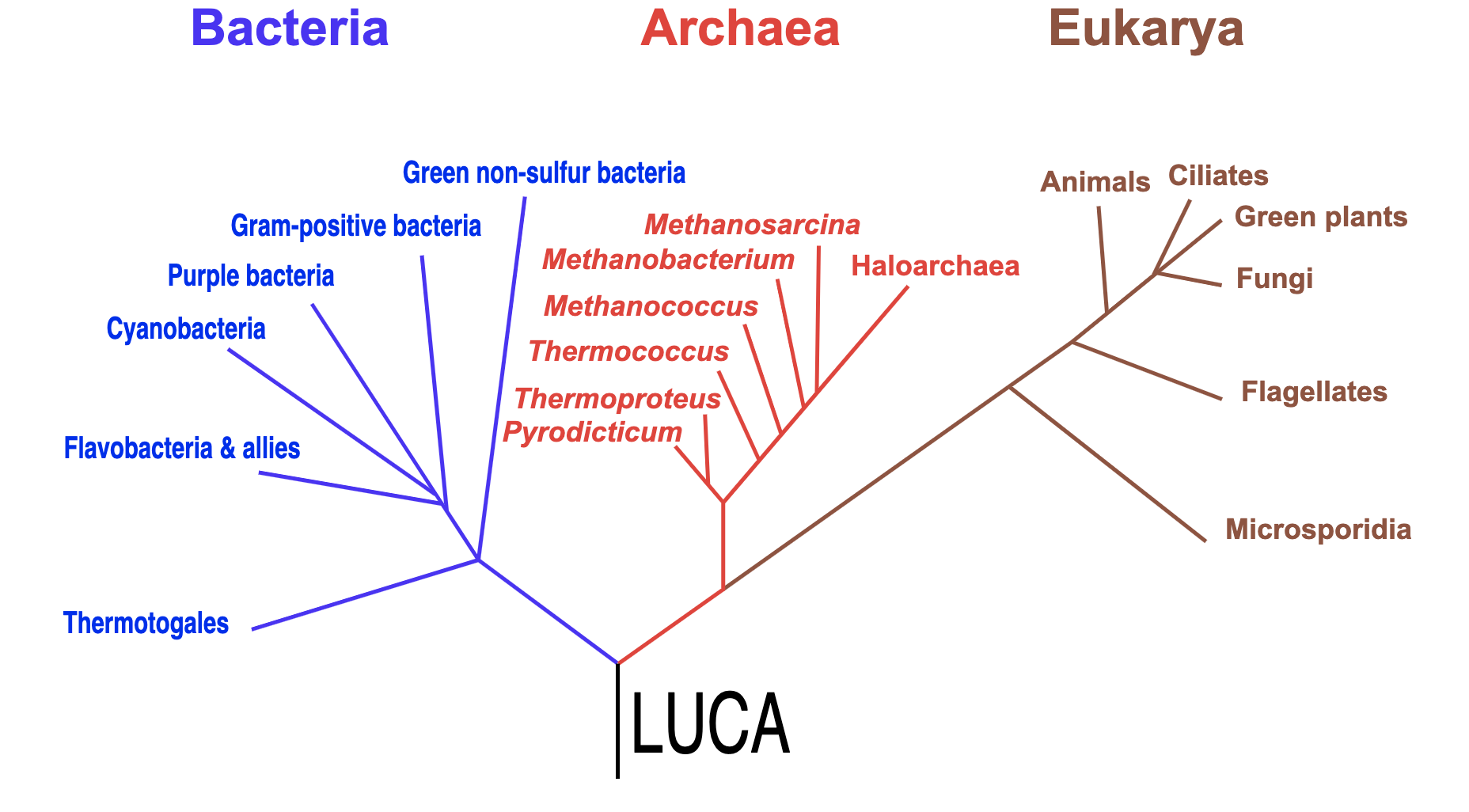
What would LUCA have looked like at this point? It was still, evidently, little more than an aggregation of organic material capable of using a proton gradient to synthesize organic compounds. It simply met the six characteristics we use to describe a living cell: an energy flow, a carbon flow, inorganic catalysts, the ability to replicate genetic material, compartmentalization in a vesicle, and excretion. We can imagine it as a vesicle lodged against a thin inorganic wall, containing mostly proteins. The vesicle’s membrane was relatively leaky, allowing protons to move in and out readily. During that flow, ATP synthase in the membrane could produce ATP. LUCA could then use the ATP to synthesize more proteins and genetic material, achieving self-replication.
Leaving the Vents: The Emergence of Antiporters
At this stage, LUCA’s membrane had to be permeable to protons. If hydrogen ions entering the cell could not leave promptly, the gradient would disappear. Protons should therefore flow from the environment into the cell through the membrane’s ATP synthase, then diffuse back out through the membrane. The electrochemical gradient drove their entry, while convection in the surrounding environment allowed them to leak away naturally. Under these conditions, there was no selective pressure for the cell to reduce its membrane’s permeability—unless it acquired a mechanism for actively pumping ions out.
The sodium–proton antiporter (Na⁺/H⁺ antiporter) fulfilled this role. It couples the energy of ion gradients by bringing in a sodium ion while pumping out a proton, or vice versa: bringing in a proton while pumping out a sodium ion. This was a major development:
- The antiporter could use the proton gradient to drive sodium ions out of the cell. Protons cross membranes much more easily than sodium ions, so incoming protons could leak back out, allowing the pumping to continue. The expelled sodium ions, meanwhile, stayed outside and maintained a sodium gradient. In effect, a proton gradient was converted into a more stable sodium gradient.
- This conversion did not eliminate the original proton gradient; it could still do its job. The antiporter therefore supplied the cell with additional energy—60% more, according to the calculation cited in the book. That extra energy let cells survive with a smaller pH difference: where they might previously have needed a difference of three pH units, they could now survive with less than two.
Cells could now survive across a wider area, spreading to nearby vents, for example. They still could not leave the vents altogether, since the ultimate source of energy remained the proton gradient. But the antiporter introduced new selective pressures:
- Reduce membrane permeability so that more sodium ions remain outside, improving energy efficiency.
- Actively pumping out protons now made sense. Previously they would simply leak back in; now some might return through the antiporter, pumping out another sodium ion. This was not guaranteed, but the possibility of gaining more energy could drive the evolution of proton pumps. Once proton pumps existed, there was even stronger pressure to reduce membrane permeability, directing more returning protons through antiporters rather than letting them leak back in.
With proton pumps and less leaky membranes, cells could finally leave the vents. Essentially, dependence on an external proton gradient had been replaced by dependence on a gradient they could generate themselves: a form of energetic autonomy.
Endosymbiosis: The Emergence of Complex Life
First, consider why bacteria and archaea did not simply grow larger. The reason lies in energy density. An individual prokaryotic cell has only one layer of proton-driven respiratory membrane. As its volume increases, its surface-area-to-volume ratio drops sharply, and its energy supply cannot keep up with the costs of gene replication and protein synthesis. Nick Lane calls this the hard limit on “energy per gene.”
Around 2.0–1.8 billion years ago, a host cell resembling modern archaea, and already capable of a primitive form of phagocytosis, accidentally retained an alphaproteobacterium inside itself. Instead of being digested, the bacterium continued to respire using its own inner membrane, becoming a primitive mitochondrion. This moved respiratory activity from a single enclosing membrane to numerous internal reactors, turning energy production from a surface-area-limited system into a parallel architecture that could scale linearly. Whenever the cell needed more energy, its mitochondria could divide, without requiring the host genome to grow at the same time. That was the key to breaking through the energy-density bottleneck.
As mitochondria multiplied, their genes were stripped away or transferred to the host’s nuclear genome over the following hundreds of millions of years. They retained only a small number of genes for core electron-transfer proteins, allowing rapid, local regulation of the respiratory chain. The result was a low-cost, indefinitely expandable system of outsourced power generation:
- Mitochondrial DNA accounted for around 1% or less, while respiratory membrane area could grow by orders of magnitude.
- The host’s nuclear genome could therefore afford more regulatory elements, spliceosomes, and signaling pathways without an energy deficit. Lane estimates that eukaryotic cells have 1,000–10,000 times more energy per gene than typical bacteria. This is what makes long introns, complex monitoring of protein folding, and extensive cytoskeletal networks affordable.
The Role of Sex
Another particularly interesting point is that endosymbiosis may be closely connected with the emergence of sex. Endosymbiosis requires tight cooperation between mitochondria and the rest of the cell: energy production must match the needs of the whole. But mitochondria replicate at their own pace and have a higher mutation rate than nuclear genes, presumably because of their intense redox activity. Under asexual reproduction, nuclear genes would struggle to keep up with mitochondrial mutations, eventually leading to a mismatch.
Sex solves this problem by using mitochondrial genes from only one parent, usually the female, during reproduction. This fixes the “target” that needs to be matched, while recombining nuclear genes from both parents to match it. It becomes easier to find new nuclear gene combinations compatible with the mitochondrial genes, with natural selection eliminating the unsuitable ones.
LECA: The Last Eukaryotic Common Ancestor
LECA (Last Eukaryotic Common Ancestor), which emerged around 1.6–1.5 billion years ago, already possessed most of the machinery shared by modern eukaryotes:
- Mature mitochondria and ADP/ATP transporters.
- A genome enclosed in a nuclear envelope, eukaryotic promoters, and spliceosomes.
- A remodelable cytoskeleton of motor proteins, microtubules, actin, and microfilaments, supporting enzyme transport and cell division.
- High-fidelity mitotic machinery, meiosis, and a sexual cycle.
- An endomembrane system—the Golgi apparatus, endoplasmic reticulum, and lysosomes—and pathways for phagocytosis and secretion.
In other words, the overall template for the complex eukaryotic cell appeared almost in one stroke following a single historical event. Much of the next 1.5 billion years of evolution consisted of local modifications to that template.
Is Complex Life Contingent or Inevitable?
It is probably both. Its contingency lies mainly in the fact that successful endosymbiosis between a bacterium and an archaeon is known to have happened only once. There was no second event, and therefore no second independent system of complex life.
Its inevitability lies in what follows: once the energy bottleneck is overcome, a series of structural and genetic innovations becomes almost an inevitable consequence of natural selection.
Lane therefore speculates that simple life may be commonplace in the universe, while complex life requires an extraordinarily rare conjunction of thermochemical conditions, membrane biochemistry, and endosymbiosis.